


Top places to photograph in North of Portugal
Updated: Oct 2
Northern Portugal is a region where dramatic granite landscapes, mist-shrouded river valleys, and wave-battered coastlines converge to create an extraordinary playground for visual storytellers. While Porto serves as the cultural gateway, venturing beyond the city limits reveals some of the most compelling scenery in Western Europe. Finding the top places to photograph in North of Portugal allows photographers of all skill levels to expand their portfolio, capture fine-art imagery suitable for wall display, and master techniques ranging from ultra-long exposures to delicate golden-hour compositions.
Whether you are packing a professional camera setup or refined mirrorless gear, this guide breaks down six exceptional locations, complete with key shooting directions, lighting strategies, and creative insights to elevate your photographic craft.
Top places to photograph in north of Portugal
Understanding where to position your tripod and when to arrive is essential for landscape success. The region's diverse microclimates—ranging from humid Atlantic coastlines to crisp mountainous borders—demand thoughtful preparation and creative adaptability. Below is a structured overview of six top places to photograph in North of Portugal, highlighting their core visual elements and ideal shooting windows.
1. Amarante: historic riverfront reflections
Nestled along the banks of the Tâmega River, Amarante offers a peaceful, painterly aesthetic that appeals instantly to landscape and architectural photographers alike. The centerpiece of the town is the São Gonçalo Bridge, a grand granite structure that spans the quiet river directly in front of the 16th-century monastery.
When planning your shoot in Amarante, early morning is your greatest ally. The river valley frequently traps cool air, producing a gentle layer of mist that hovers directly above the water surface. This mist serves as a natural diffuser, softening background elements and emphasizing the strong, centuries-old stonework of the bridge.
Compositional tip: Set up your tripod along the lower eastern embankment. Position the reflection of the bridge’s main arch cleanly in the lower third of your frame. If the water surface exhibits minor ripples, employ an stop or 6-stop neutral density (ND) filter to extend your shutter speed to 15–30 seconds, smoothing the water into a flawless mirror.
Lighting strategy: Shoot at dawn before the sun clears the surrounding hillsides. The soft, indirect light preserves highlight details on the white monastery facade while capturing rich tones in the granite structures.

Senhor da Pedra: coastal chapel among Atlantic waves
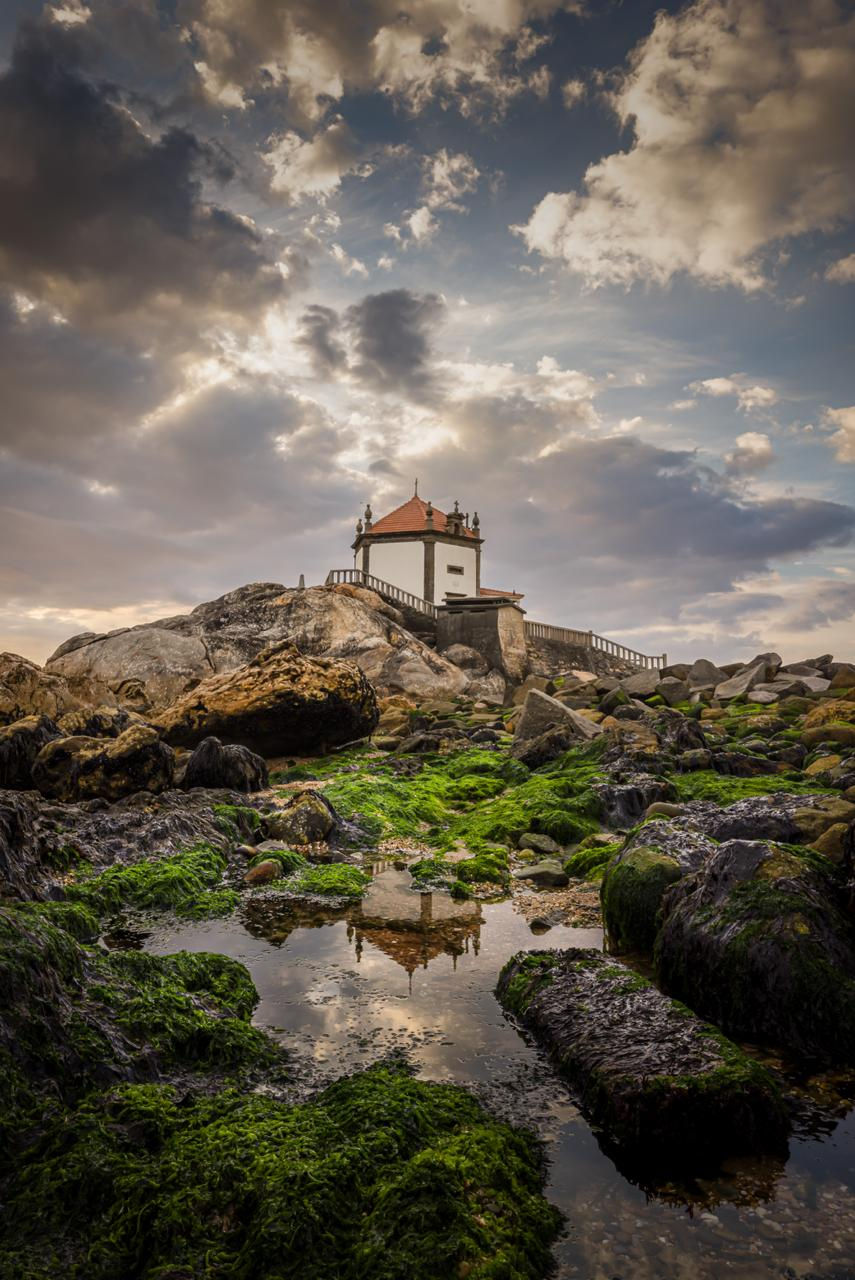
Situated on Miramar beach in Vila Nova de Gaia, the chapel of Senhor da Pedra is arguably one of the most distinctive coastal photography subjects in Western Europe. Constructed in 1686 directly on a rocky outcrop where ocean tides surge across the sand, the chapel presents a striking contrast between human heritage and raw oceanic power.
To capture the true mood of Senhor da Pedra, pay close attention to the tide tables. During high tide, incoming Atlantic swells wash around the base of the rock formation, completely surrounding the chapel with water.
Compositional tip: Keep your camera low to the beach to incorporate leading lines formed by wet sand or retreating foam. A wide-angle lens (16mm to 24mm on full-frame) allows you to capture the grand scale of the open sky while keeping the chapel firmly anchored in the frame.
Technical execution: Use a polarizing filter to control glare on the wet sand, paired with a 10-stop ND filter to turn ocean spray into ethereal mist. A shutter speed between 2 and 5 seconds strikes an ideal balance, blurring the wave motion while retaining texture in the water movement. Always monitor incoming waves closely to safeguard your equipment.
Windmills of Apúlia: sand dunes and maritime heritage
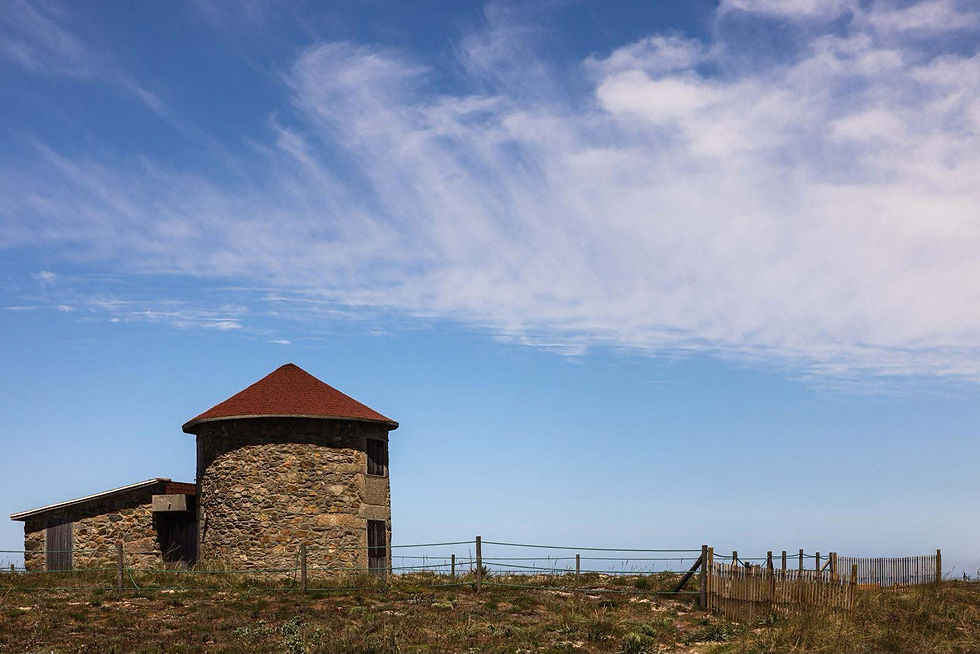
Further north along the Esposende coastline, the beach of Apúlia features a series of historic stone windmills perched atop grassy sand dunes. Built to withstand relentless Atlantic gales, these circular structures were originally used to grind locally harvested grain. Today, they serve as dramatic focal points for coastal landscape imagery.
The environmental context here is exceptional. Elevated wooden boardwalks wind through fragile dune ecosystems, providing ready-made geometric leading lines that direct the viewer's eye straight toward the windmills.
Compositional tip: Frame your shot along the boardwalk paths during golden hour. Align the wooden handrails so they sweep from the lower corner of the frame toward the central windmill structure. This adds profound depth to your print compositions.
Lighting strategy: Aim for late afternoon lighting when the sun sits low in the west. The warm, directional light grazes the side of the stone mills, highlighting their rugged masonry texture while casting long, soft shadows across the golden sand dunes.
Chaves: Roman history along the Tâmega River
Situated near Portugal's northern frontier with Spain, Chaves is an ancient thermal city anchored by two millennia of history. The prime photographic destination in Chaves is the Roman Trajan Bridge (Ponte de Trajano), built between the end of the 1st century and the beginning of the 2nd century AD. Its stone arches remain a testament to Roman engineering.
Because Chaves lies further inland, the atmosphere here feels distinctly calm and historical. The Tâmega River flows gently beneath the bridge arches, presenting opportunities for pristine reflections and serene night or twilight photography.
Compositional tip: Position yourself along the riverside park promenade downstream from the bridge. A focal length of 35mm to 50mm compresses the scene gracefully, allowing you to include both the ancient stone arches and the traditional colorful houses lining the background.
Lighting strategy: Plan your visit for blue hour—the 20-minute window after sunset when the ambient sky turns deep blue and the warm artificial lights on the bridge illuminate. The color contrast between the cool sky and warm stone creates striking fine-art images.

Aveiro and Costa Nova: vibrant coastal architecture
Often referred to as the Venice of Portugal due to its urban canal system and traditional moliceiro boats, Aveiro is a vibrant cultural hub. However, for landscape and architectural photographers, the real jewel lies just west along the coastal strip of Costa Nova.
Costa Nova is famous for its palheiros—wooden fishermen’s cottages painted with bold, vertical stripes of red, blue, green, and yellow. These structures line the waterfront promenade, providing a colorful aesthetic that stands out sharply against typical coastal scenery.
Compositional tip: Adopt a clean, minimalist approach. Look for flat, head-on perspectives that isolate individual facades or capture a repeating rhythm of striped patterns. Using a 50mm focal length helps keep lines straight and prevents wide-angle barrel distortion.
Lighting strategy: Contrary to typical landscape photography rules, Costa Nova often looks best on bright, overcast days. Soft, diffused cloud cover eliminates harsh midday shadows and prevents blown-out highlights on the white painted stripes, allowing the rich saturated colors to translate beautifully to print.
Casa de Mateus in Vila Real: baroque elegance and still water
Located in the historic Trás-os-Montes region near Vila Real, Palácio de Mateus (Casa de Mateus) is widely regarded as a pinnacle of Portuguese baroque architecture. Built in the 18th century, the estate features elaborate roof pinnacles, white stucco walls trimmed in dark granite, and meticulously sculpted formal gardens.
The ultimate landscape shot at Casa de Mateus hinges on the large ornamental reflection pond situated directly in front of the palace facade. The pool acts as a liquid mirror, doubling the architectural splendor when conditions are calm.
Compositional tip: Place your tripod low near the water's edge, using a small aperture (f/8 to f/11) to maintain front-to-back sharpness across both the real building and its underwater reflection. A centered composition works effectively here to accentuate symmetrical harmony.
Seasonal timing: Autumn is particularly striking around Vila Real. The surrounding manicured boxwood gardens, chestnut trees, and nearby Douro Valley vineyards turn brilliant shades of orange and gold, adding rich warm hues to your frame.
Technical guidance for photographing Northern Portugal
Exploring these top places to photograph in north of portugal requires dynamic technical execution. Coastal humidity, sudden ocean breezes, and variable light require thoughtful field preparation.
Exposure management: Use your camera’s live histogram rather than relying solely on the rear LCD screen. Coastal fog or bright river reflections can easily fool your camera's internal meter, leading to under-exposed shadows or clipped highlight details.
Filter essentials: Carry a high-quality circular polarizer to strip unwanted reflections from wet rocks and foliage, along with a set of neutral density filters (3-stop, 6-stop, and 10-stop). ND filters are indispensable when photographing motion in coastal locations like Miramar or Apúlia.
Gear protection: Salt spray along the Atlantic coast can accumulate quickly on optical elements. Always carry micro-fiber cloths, lens cleaning fluid, and a rain cover for your camera body. Ensure your tripod feet are rinsed with fresh water after working in wet sand or salt water.
Print mindset: When composing your frame, think beyond the digital display. Consider how edge details, tonal depth, and negative space will translate when printed on archival paper or metallic canvas for home gallery display.
Book you guided photo tour in the North of Portugal, click here to know more
Frequently asked questions
Do I need to rent a car to visit these photography spots in Northern Portugal?
Renting a car is strongly recommended. While places like Aveiro and Amarante are accessible via train or regional bus from Porto, having your own vehicle gives you total freedom to arrive at remote spots like the Apúlia windmills, Chaves, or Casa de Mateus well before sunrise or stay long after sunset when public transit is unavailable.
What camera gear should I pack for a landscape photography trip near Porto?
A versatile setup includes a weather-sealed full-frame or APS-C camera body, a ultra-wide lens (16-35mm equivalent) for coastal vistas, a standard zoom (24-70mm equivalent) for architectural reflections, a sturdy carbon-fiber tripod, circular polarizers, and neutral density filters.
What is the best season for landscape photography in Northern Portugal?
It depends on what kind of picture your are looking for. With that in mind, Spring (April to June) and Autumn (September to November) offer optimal conditions. Spring brings lush foliage, full rivers, and clear atmospheric light, while Autumn delivers warm foliage tones in inland regions like Vila Real and dramatic, stormy skies along the coast without peak summer tourism crowds.


Comments